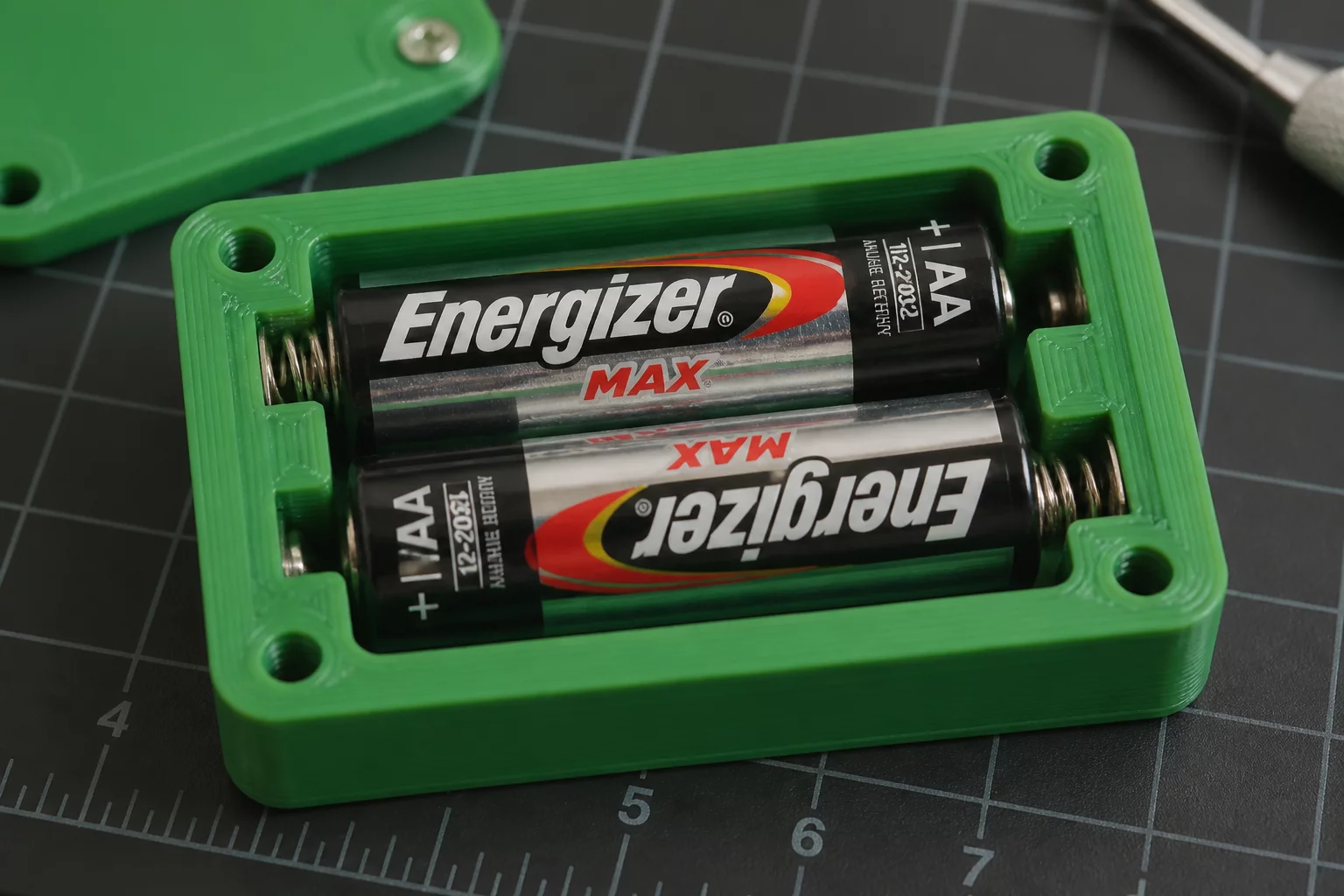
The challenge of housing standard AA batteries in 3D printed enclosures often boils down to a single tenth of a millimeter. In this case study, we examined how thermal contraction and wall thickness interact to create either a perfect sliding fit or a frustratingly stuck cell. When working with materials like PETG, the slight elasticity is beneficial for snap-fit lids, but the internal cavity must be precisely calibrated to account for the "elephant's foot" effect on the first few layers, which can narrow the compartment entrance. We tested three distinct offsets in the CAD design, ranging from a tight 0.1mm clearance to a loose 0.3mm gap. The goal was to find the point where the battery stays secure during vibration but can be removed with moderate finger pressure.
The analysis also looked at the impact of infill density on the structural integrity of the spring-contact walls. It is vital that repeated insertions do not lead to fatigue cracks or permanent deformation of the plastic. We found that using a higher wall count (3-4 loops) significantly improved the durability of the thin dividers between battery cells, providing a much more robust mechanical feel compared to single-wall iterations that relied on infill for support.
Technical Iteration Analysis
Final Acceptance Decision
The iteration using a 0.2mm total diameter offset achieved the best balance. While the 0.1mm version offered a very "premium" feel, it failed when using batteries with slightly thicker plastic wraps or inconsistent diameters. The 0.2mm version accommodates various battery brands without compromising the secure feel of the enclosure. For production, we recommend using a 3-wall loop setting to ensure the thin dividers between cells remain rigid and functional over the lifecycle of the device.