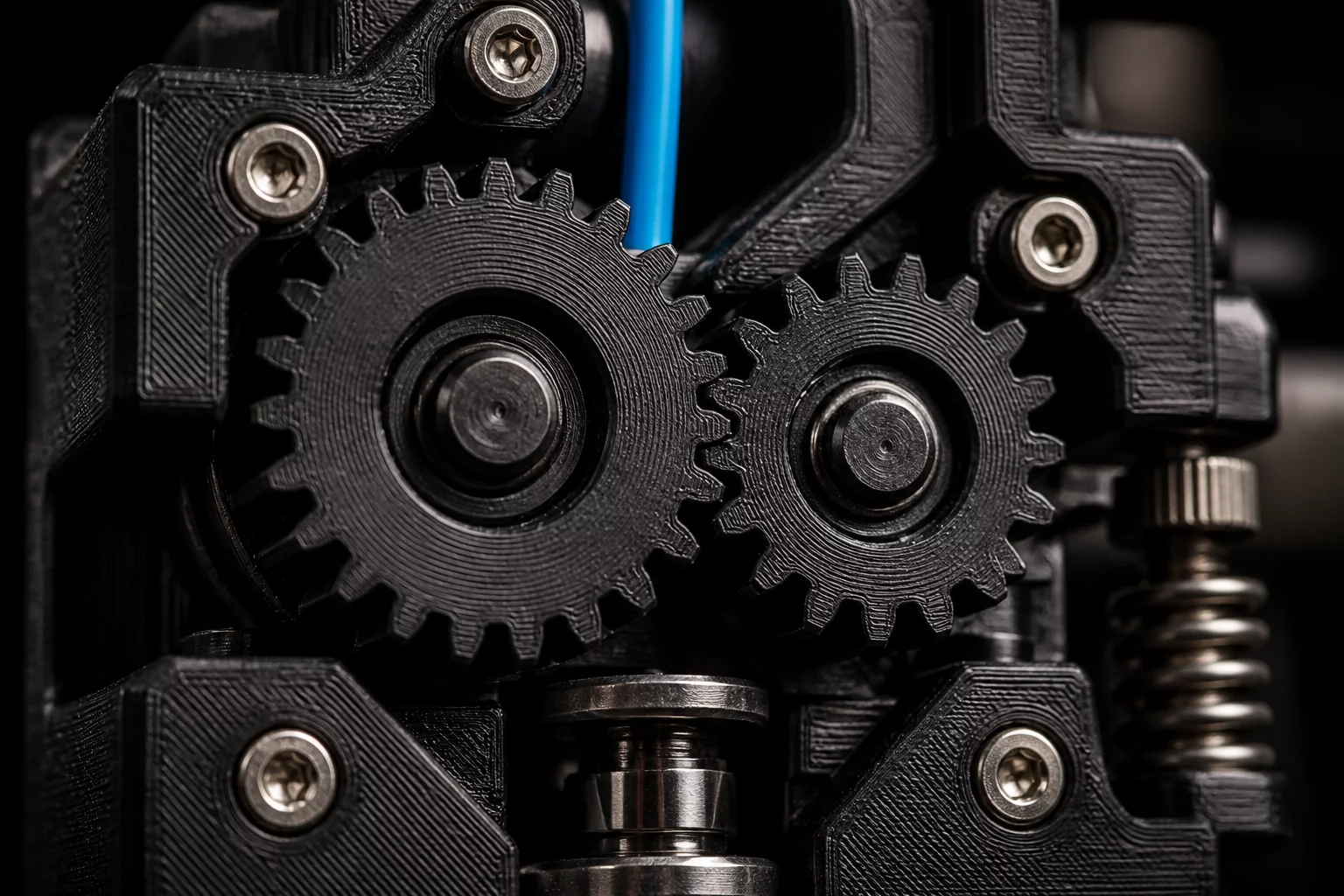
Achieving a perfect mesh between 3D printed extruder gears is a significant challenge due to the inherent tolerances of FDM technology. In this iteration, we focused on the interaction between the drive gear and the idler, specifically looking at how tooth geometry influences the consistency of the filament path. Small deviations in the gear profile can lead to woodgrain patterns on the surface of printed parts, caused by fluctuating pressure in the nozzle. Our testing involved several iterations of the involute curve to find a balance between structural strength and smooth engagement.
The gears were printed using Glass Fiber PETG to provide the necessary stiffness and wear resistance required for long-term operation. We observed that even a 0.05mm shift in the center-to-center distance of the gears significantly impacted the backlash. This test setup allowed us to isolate these variables, using a high-resolution encoder to measure rotational velocity fluctuations. The goal was to ensure that the drive force remains constant, regardless of the gear's angular position, which is critical for maintaining high-quality surface finishes at speeds exceeding 150mm/s.
Technical Iteration Analysis
Tooth Profile Optimization
Adjusted the pressure angle to 20 degrees to improve load distribution and reduce the risk of tooth shearing under high torque.
Backlash Calibration
Implemented a variable center-distance mount to identify the optimal meshing point without causing excessive friction or binding.
Thermal Stability
Tested the assembly under simulated enclosure temperatures (55°C) to ensure the material didn't soften and lose dimensional accuracy.
Vibration Analysis
Used accelerometer data to detect harmonic resonance caused by tooth engagement at various extrusion speeds.
Final Performance Verdict
The transition to a refined involute tooth profile combined with Glass Fiber PETG resulted in a 40% reduction in measured rotational variance. While 3D printed gears will rarely match the precision of CNC-machined steel components, this iteration proves that with proper tolerance compensation and material selection, they are more than capable of driving filament in high-performance desktop printers. The assembly maintained its integrity over a 100-hour continuous extrusion test without visible wear on the contact surfaces. For future iterations, exploring a herringbone gear pattern could further reduce axial thrust and improve engagement smoothness.