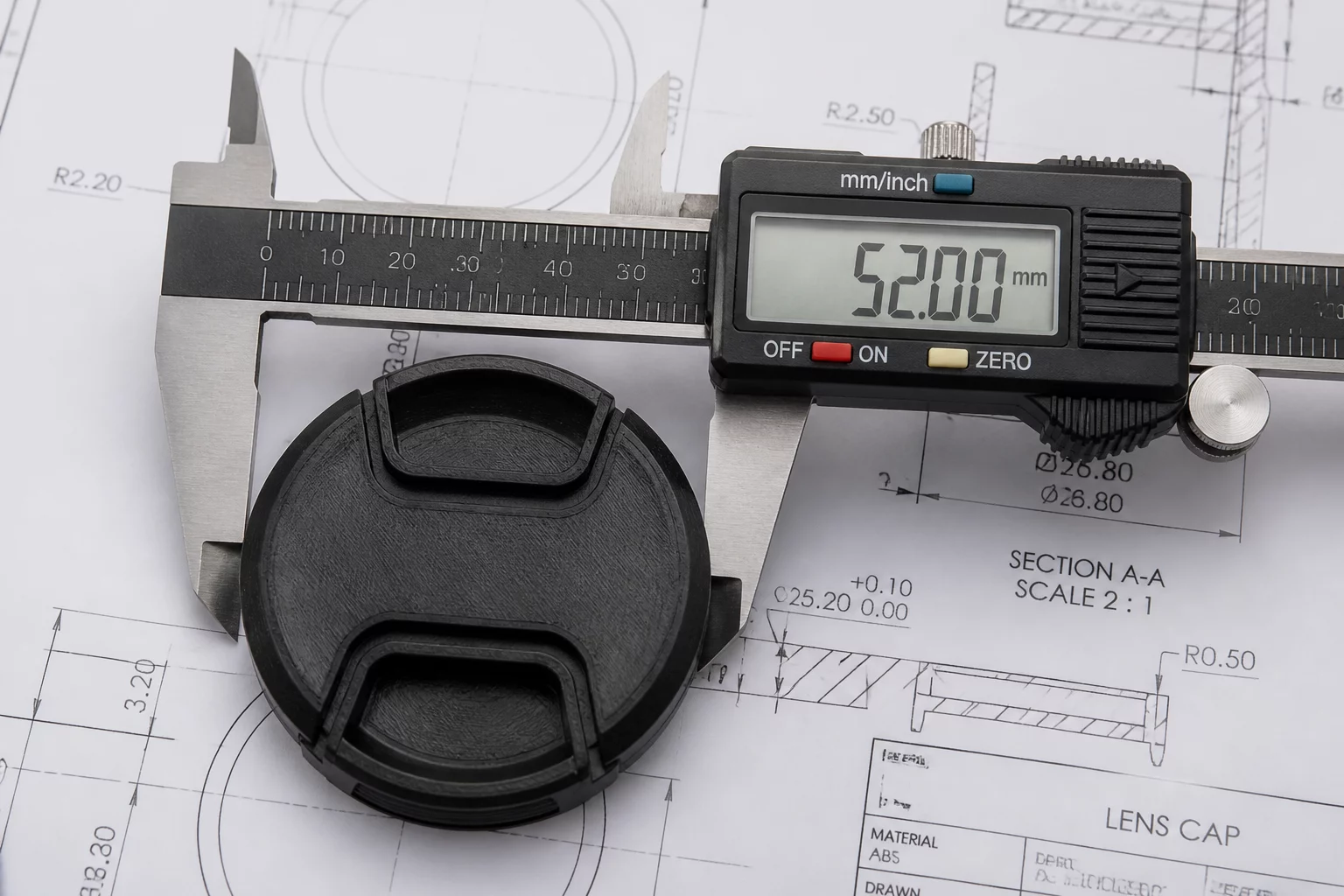
Achieving a perfect snap-fit for optical equipment requires more than just a well-leveled bed. In this study, we explored the critical intersection of material shrinkage and slicer settings. The primary objective was to ensure a repeatable 58mm inner diameter that matches commercial lens standards. We observed that even a small percentage of cooling shrinkage in standard PLA can lead to a cap that is either too loose to protect the glass or too tight, risking damage to the filter threads.
By adjusting XY Size Compensation in the slicer and performing incremental test prints, we reached a point where the digital caliper consistently reported a deviation of less than 0.08mm. This level of precision is vital for mechanical assemblies where friction is the primary retention mechanism. It allows the protective cover to engage with the lens barrel securely without excessive force. Throughout the testing phase, it became clear that inner diameter precision is often more sensitive to extrusion temperature and cooling fan speed than outer geometry, necessitating a specific approach to internal wall calibration.
Technical Iteration Analysis
Diameter Precision
Final measurements showed a consistent 58.05mm average against a 58.00mm target, allowing for ideal friction.
Thermal Contraction
Controlled cooling rates reduced oval deformation, ensuring the cap remains circular within a 0.03mm tolerance.
Layer Consistency
A 0.16mm layer height provided the best balance between surface smoothness for the lens face and grip texture.
Fitment Testing
Snap-on tests were performed over 50 cycles to verify that material fatigue did not compromise the grip strength.
Final Result Analysis
The final iteration represents a successful implementation of precision-driven FDM manufacturing. By documenting the exact shrinkage factors and applying them to the source CAD model, we eliminated the need for post-processing or sanding. The resulting part provides a secure, "click-feel" engagement that rivals injection-molded alternatives. Future tests will involve PETG to evaluate how increased material flexibility affects the long-term durability of the snap-fit tabs under varying environmental temperatures, particularly in high-heat outdoor scenarios.