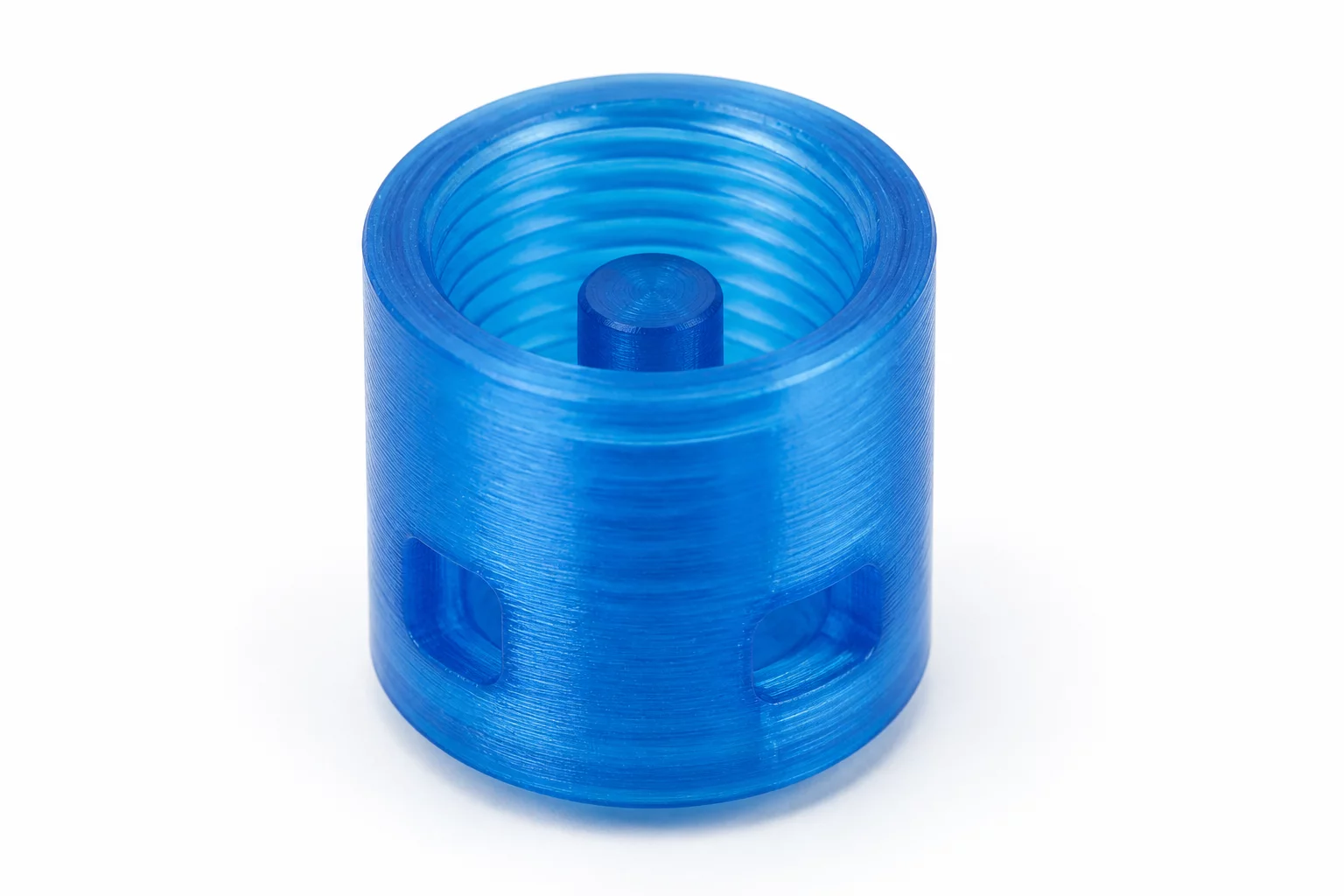
Achieving a reliable liquid seal in FDM (Fused Deposition Modeling) environments requires a significant departure from standard printing profiles. Conventional prints are inherently porous due to the micro-gaps created between layer lines and perimeters. For the Valve Core Liquid Seal project, the primary challenge was to create a component that could withstand 2.5 bars of pressure without the aid of chemical sealants or external epoxy coatings.
Initial iterations revealed that water would consistently weep through the Z-seams and the junctions where the infill met the inner perimeters. To resolve this, we implemented a strategy focused on "over-packing" the plastic. By increasing the flow rate of the inner walls to 105% and using a translucent PETG, we were able to visually verify that the perimeters were fusing into a single, monolithic barrier. The use of PETG was critical here, as it offers superior chemical resistance and better layer adhesion compared to standard PLA, which tends to be more brittle and prone to micro-cracks under hydraulic stress.
The final design incorporated a modified thread profile with an integrated compression lip. When the valve core is tightened into its housing, this lip undergoes a slight deformation, creating a mechanical crush-seal that compensates for the surface irregularities typical of 3D prints. This case study demonstrates that with the right combination of geometric innovation and targeted slicer adjustments, 3D printed parts can move beyond cosmetic prototypes into functional, pressure-rated engineering components.
Technical Iteration Analysis
Perimeter Density
Increased wall loop count from 3 to 6 to create a solid plastic barrier, effectively eliminating internal porosity.
Flow Rate Calibration
Boosted inner wall flow to 105% to ensure maximum overlap between perimeters, closing micro-gaps.
Seam Randomization
Changed seam alignment to random to prevent the formation of a continuous vertical leak path.
Thermal Bonding
Printed at the upper limit of the material thermal range to maximize inter-layer adhesion and structural seal.
Final Performance Metrics
The final iteration successfully passed a 24-hour static pressure test at 3 bars. By optimizing the specific wall bonding settings and material temperature, we achieved a leak-free component that rivals low-pressure injection molded equivalents. The component has been validated for use in water-cooled systems, proving the viability of high-detail FDM for liquid handling. This success establishes a new internal standard for watertight housings within the PartTrace technical framework.