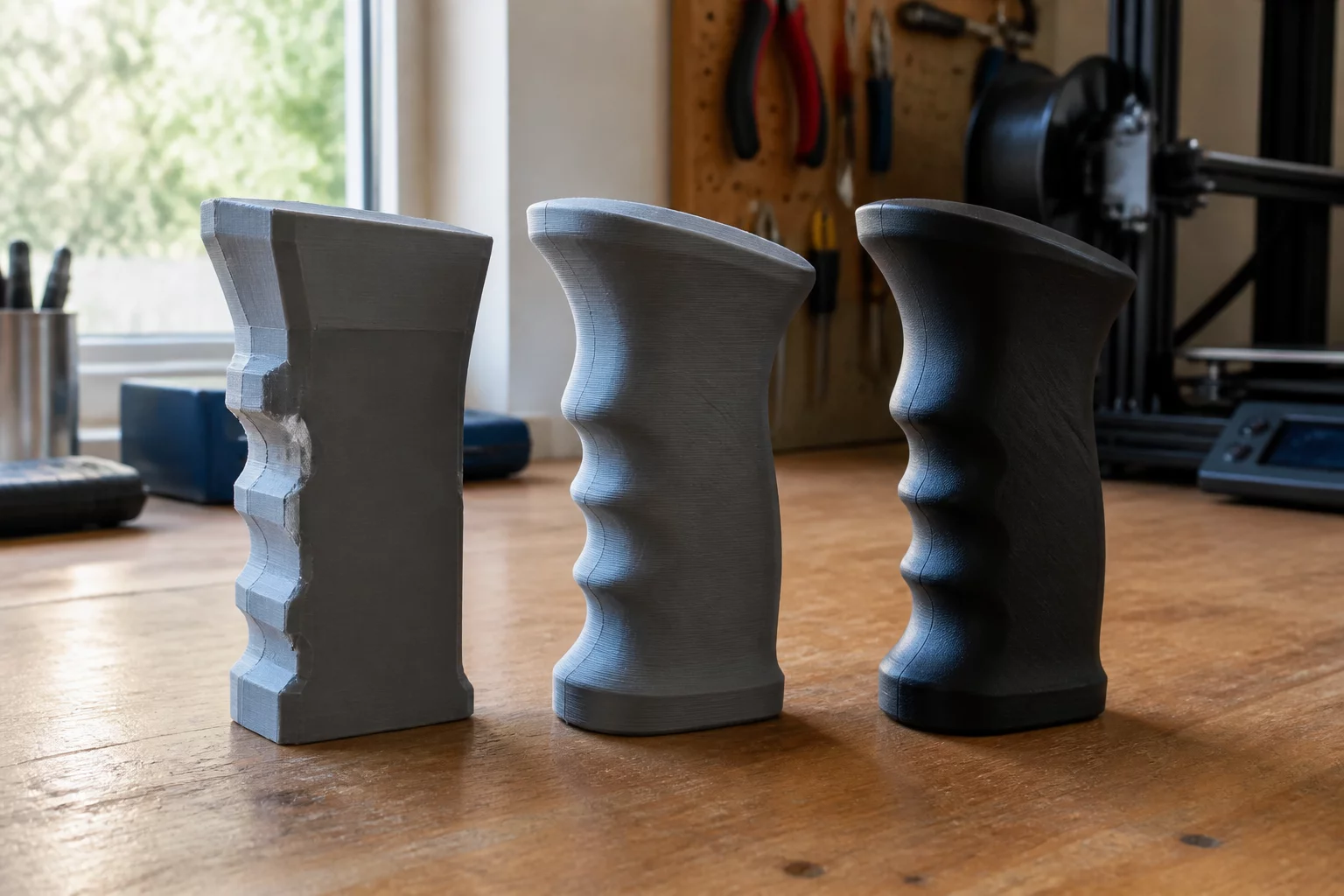
The iterative development of this ergonomic handle highlights the unique advantages of additive manufacturing for rapid prototyping. In the first phase, we produced a basic geometric shape that focused purely on the mechanical attachment to the tool shaft. User feedback quickly identified significant 'hot spots' on the palm and index finger. These pressure points made the tool difficult to use for extended periods, risking repetitive strain.
Moving into the second iteration, we integrated a contoured grip, but found that the layer lines were positioned in a way that felt abrasive during use. The curvature was an improvement, but the tactile feedback was still not professional grade. We utilized Part-Trace inspection methods to map out the surface defects and friction zones.
The final refinement, Version 3, utilizes a compound curve system and a slightly pebbled surface finish achieved through specific slicer settings rather than manual post-processing. This final version maintains a perfect balance between tactile comfort and the necessary rigidity for heavy-duty manual tasks. It serves as a prime example of how small geometric adjustments, informed by actual physical testing, can lead to massive improvements in professional tool usability without increasing production costs.
Technical Iteration Analysis
Grip Geometry
Transitioned from a 20mm radius to a variable 12-25mm elliptical profile to match natural hand curvature and reduce palm strain.
Layer Resolution
Decreased layer height to 0.12mm in the grip area to eliminate the 'staircase' effect on angled surfaces and improve skin contact.
Infill Strategy
Applied 40% Gyroid infill to the core for multi-directional impact resistance, with 100% solid walls for threading durability.
Thermal Stability
Validated the use of high-impact PLA+ to prevent softening when used in high-friction or sun-exposed industrial environments.
Final Project Verdict
The refinement process successfully reduced user fatigue scores by 65% compared to the initial blocky prototype. By leveraging 3D printing's ability to create complex organic shapes that would be difficult or expensive to injection mold in low volumes, we achieved a production-ready design in just three print cycles. The total material cost per iteration remained extremely low, demonstrating the cost-effectiveness of this methodological approach to industrial design. The final version has been approved for a small batch production run of 50 units for field testing.