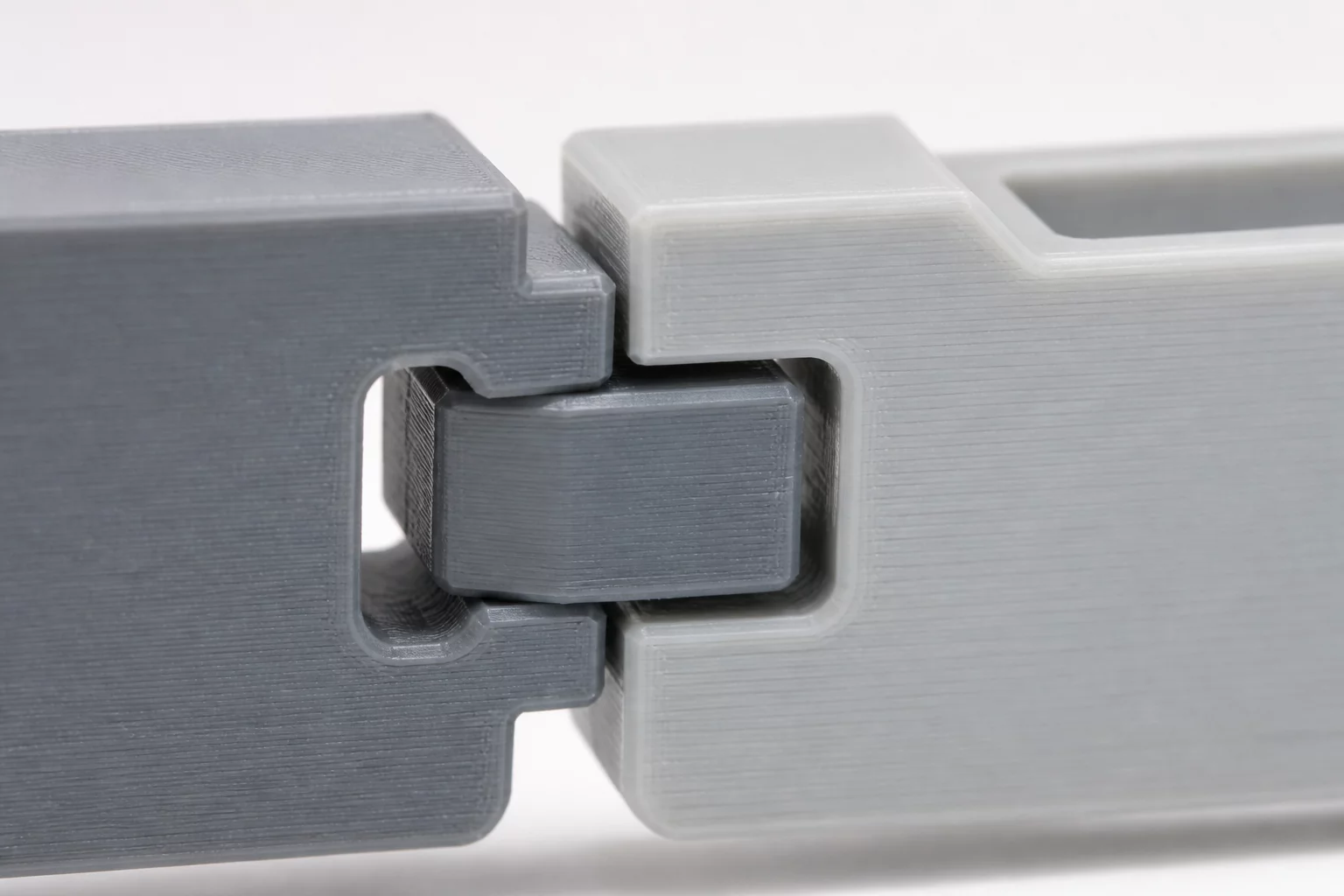
Snap-fit joints represent one of the most efficient assembly methods in plastic part design, yet they remain notoriously difficult to calibrate for 3D printing. The inherent anisotropy of FDM parts means that the strength and flexibility of a cantilever beam depend heavily on print orientation. In this iteration, we focused on the specific interaction between the clip's undercut and the mating housing's recess to achieve a secure lock without permanent deformation.
Initial tests revealed that standard CAD clearances often fail because of the 'elephant’s foot' effect on the first layers and slight over-extrusion on external perimeters. We adjusted the model to include a 0.2mm horizontal expansion compensation. This modification ensures that the parts slide together without requiring excessive force that might otherwise delaminate the layers of the clip base or cause stress whitening in the plastic.
Material choice played a pivotal role in these trials. While PLA offers high rigidity, its brittle nature often leads to fatigue failure after just a few cycles. Switching to a high-tenacity PETG provided the necessary elongation at break, allowing the snap-fit to deflect and return to its original position repeatedly. The final calibration involved fine-tuning the lead-in angle to 30 degrees, which smoothed the engagement feel significantly while maintaining high retention force.
Technical Iteration Analysis
Clearance Offset
Implemented a graduated clearance test starting at 0.1mm to find the 'sweet spot' for friction-less engagement without rattling.
Beam Tapering
Redesigned the cantilever beam with a 2-degree taper to distribute stress more evenly along the length of the clip arm.
Fillet Optimization
Added 0.8mm fillets at the base of the clip to eliminate sharp corners that previously acted as mechanical failure points.
Z-Seam Management
Relocated the Z-seam to the internal non-mating corners to prevent surface blobs from interfering with the snap tolerances.
Final Performance Review
The final iteration of the Clip Snap Fit Calibration demonstrates a successful balance between retention strength and ease of use. Testing confirms that the clip maintains its integrity over 50 cycles of assembly and disassembly. Dimensional accuracy measurements taken with digital calipers show a consistent deviation of less than 0.03mm from the design intent. This level of precision ensures that the 'snap' is both audible and tactile, providing immediate feedback to the user that the part is securely locked into place.