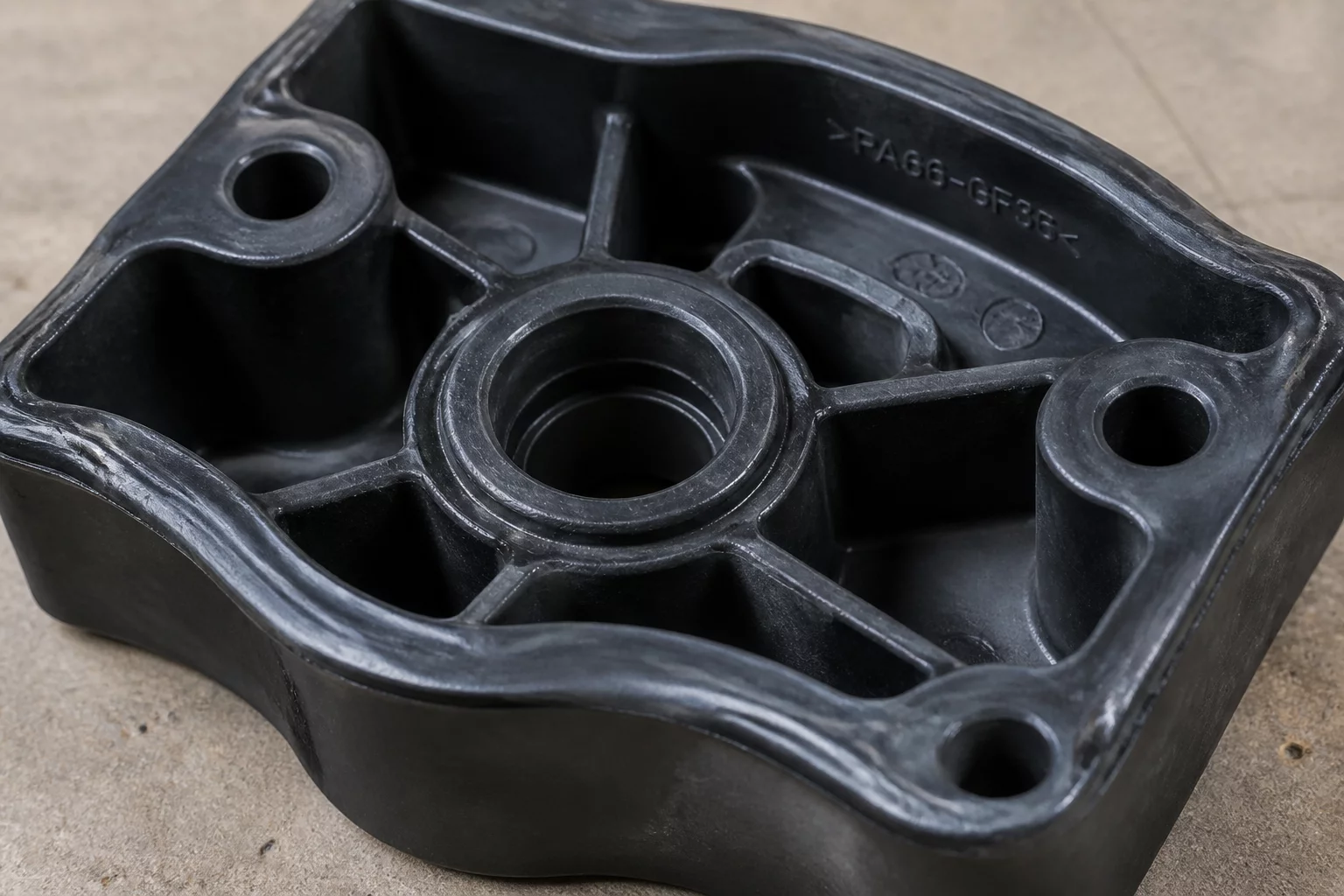
This case study focuses on a critical failure observed in a 3D printed motor mount designed for an industrial automation prototype. The component serves as the primary interface between a high-performance brushless motor and a rigid aluminum chassis. During extended operational cycles, the motor generates significant heat, which transfers directly through the mounting bolts into the plastic structure. This thermal energy eventually compromises the mechanical properties of the part, leading to what we identify as heat deflection.
Visual inspection of the failed iteration reveals significant warping around the mounting holes. The plastic has softened and flowed under the tension of the bolts, causing the motor to tilt away from its intended axis. This misalignment introduces vibration into the drive system and increases wear on connected belts and pulleys. It represents a classic case where the material's glass transition temperature was not adequately matched to the operational environment.
The original part used a standard PLA filament. While PLA offers excellent dimensional accuracy and ease of printing, its low thermal resistance makes it unsuitable for environments exceeding 50 degrees Celsius. In this application, the motor surface reached temperatures of 65 degrees, which is well above the point where PLA begins to lose its structural rigidity. The following analysis breaks down the specific points of failure and suggests the necessary adjustments for the next iteration.
Technical Iteration Analysis
Thermal Environment
The motor operates at a steady-state temperature of 65°C, creating a continuous heat soak into the mount.
Material Limitation
Standard PLA was used, which has a glass transition temperature of approximately 55-60°C.
Structural Failure
The 3mm thick mounting flange deformed under the 4Nm torque applied to the fastening bolts.
Alignment Shift
Post-test measurements showed a 1.2mm axial deviation, leading to belt slipping and audible resonance.
Iteration Recommendations
The results of this test demonstrate that material selection must prioritize thermal stability over print aesthetics for functional mechanical parts. To resolve the heat deflection issue, the next iteration must transition to a high-temperature material such as ABS, ASA, or a specialized heat-resistant PLA. Additionally, increasing the infill density and adding reinforcing ribs around the mounting points will help distribute the mechanical load across a larger surface area. Consider adding a thermal isolation gasket between the motor and the mount to further reduce direct heat transfer.