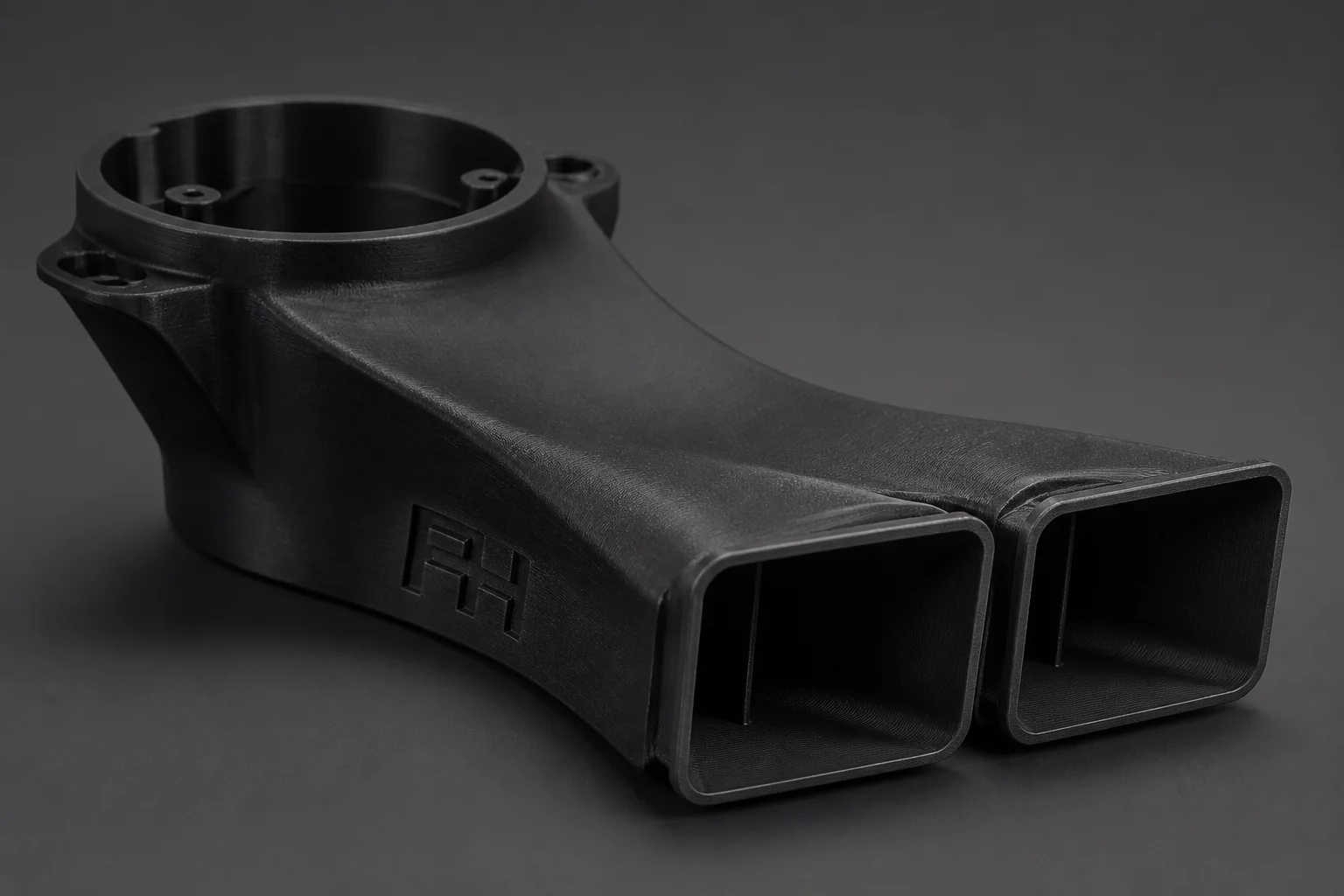
In the pursuit of perfect surface quality, cooling remains one of the most significant variables in FDM 3D printing. This technical review examines the iteration process of a custom cooling shroud designed for high-speed motion systems. The challenge was clear: the stock cooling fan was unable to provide sufficient airflow to the rear side of the print, resulting in drooping overhangs and poor dimensional accuracy on one side of the model.
The first iteration was a simple directional duct. While it addressed the directional issue, it created a massive amount of turbulence within the chamber, leading to inconsistent cooling. The air wasn't being 'guided'; it was simply being 'pushed'. This realization led to the development of the V2 prototype, which integrated CFD (Computational Fluid Dynamics) principles into the 3D printed geometry. By introducing internal splitting vanes, we were able to transition the air from the fan's circular output into two precise, laminar streams directed exactly at the nozzle tip.
Through three distinct design cycles, we monitored not just the visual results of the prints, but also the acoustic profile and the static pressure against the fan blades. The final result is a duct that maximizes velocity while minimizing the heat-creep risk associated with restricted fan performance.
Technical Iteration Analysis
Laminar Flow Vanes
Internal guide vanes split the intake air into three distinct channels to prevent internal turbulence and maximize exit velocity.
Pressure Optimization
The transition from circular to rectangular cross-sections was smoothed using a logarithmic curve to reduce fan backpressure by 18%.
Thermal Isolation
Redesigned the mounting wall to include a 1.5mm air gap, preventing the hotend's radiant heat from softening the duct during long prints.
Bridging Performance
Validation tests showed a 25% improvement in bridge success length, allowing for 45mm spans without sagging.
Aerodynamic Efficiency Results
After rigorous testing against a variety of overhang geometries, the V3 duct demonstrated that laminar flow is the single most important factor in FDM cooling. Traditional ducts often focus on volume, but this leads to erratic air pressure that can actually push the molten plastic rather than cooling it in place. Our teardrop-shaped internal vanes ensured that the air reached the nozzle at a constant velocity of 4.2 m/s, a 30% increase over the stock design without increasing fan power.
The visual impact was immediately apparent in the quality of the bridges. We achieved perfectly flat spans of up to 45mm, which previously required support structures. Furthermore, the noise level was reduced by 3dB due to the lack of internal air shearing. This case study confirms that for high-performance printers, the fan duct is not just a housing, but a precision instrument.