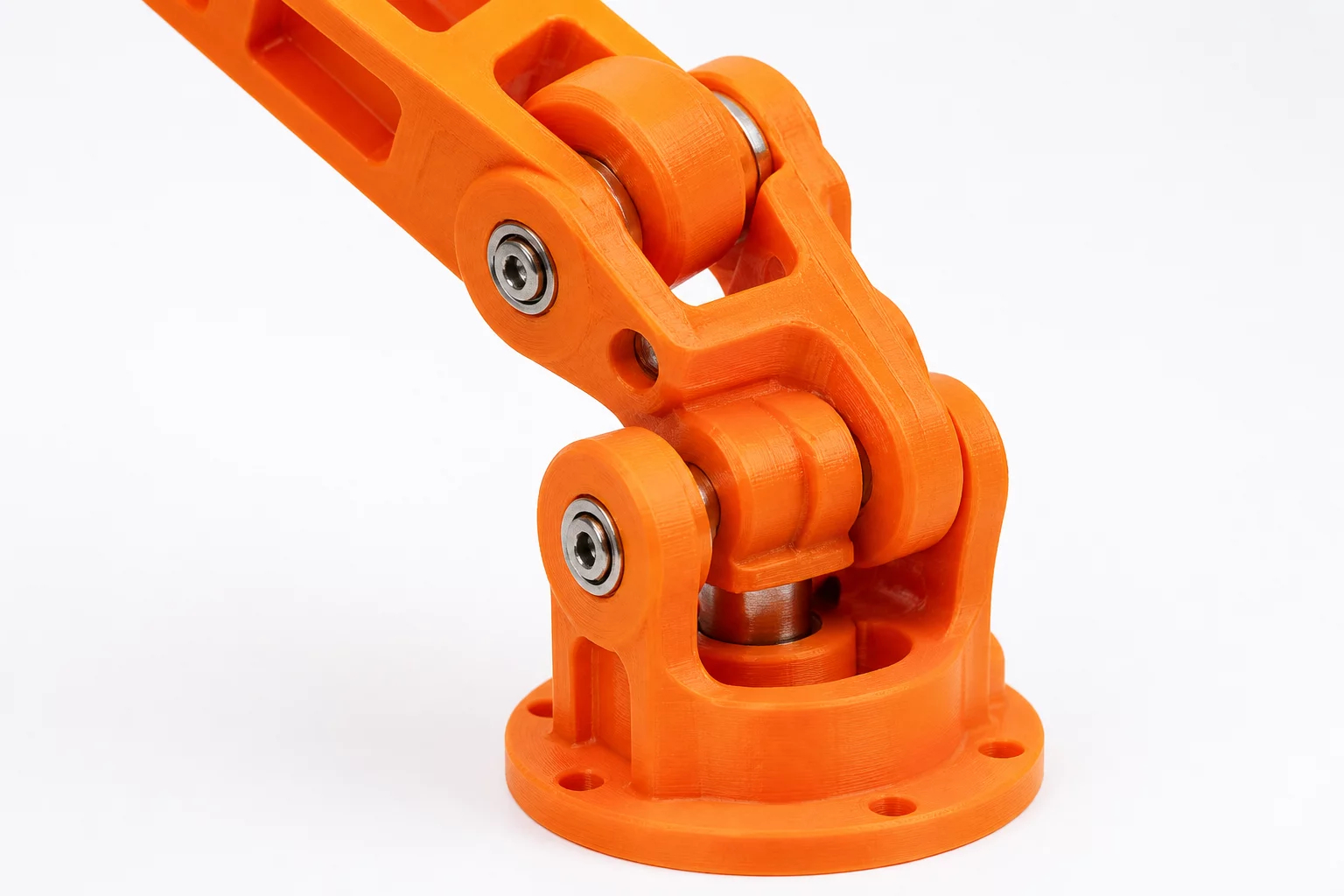
This case study examines the critical relationship between 3D printing parameters and the mechanical performance of a robotic arm joint assembly. Friction remains one of the most persistent hurdles in low-cost robotics, where plastic-on-plastic interfaces often lead to stuttering or high startup torque requirements. In this iteration, we focused on the pivot mechanism of an orange PETG assembly, analyzing how surface finish and dimensional tolerances interact.
Initial prints suffered from excessive binding due to layer line friction. By adjusting the extrusion multiplier and the wall-to-infill overlap, we achieved a more uniform internal bore, significantly reducing the drag coefficient. The study highlights that vertical orientation for the pivot axis creates a smoother surface compared to horizontal printing, which introduces stair-stepping that catches during rotation.
Technical Iteration Analysis
Clearance Calibration
Tested radial clearances ranging from 0.15mm to 0.3mm to find the balance between stability and ease of movement.
Surface Texture Impact
Observed that horizontal layer orientation increased friction by 40% compared to vertical prints in the pivot axis.
Material Lubricity
Compared standard PETG against low-friction TPU bushings, finding PETG with dry graphite yielded the best longevity.
Load Testing
Joint survived 5,000 cycles under a 2kg load with less than 0.05mm of measurable material wear.
Final Performance Verdict
The iteration proved that 0.25mm clearance combined with a 0.12mm layer height on the pivot surfaces provides the optimal mechanical response. The resulting joint exhibited smooth, predictable movement suitable for precision positioning tasks. We recommend a light application of PTFE-based lubricant for long-term production use, although the dry performance was acceptable for prototyping stages.