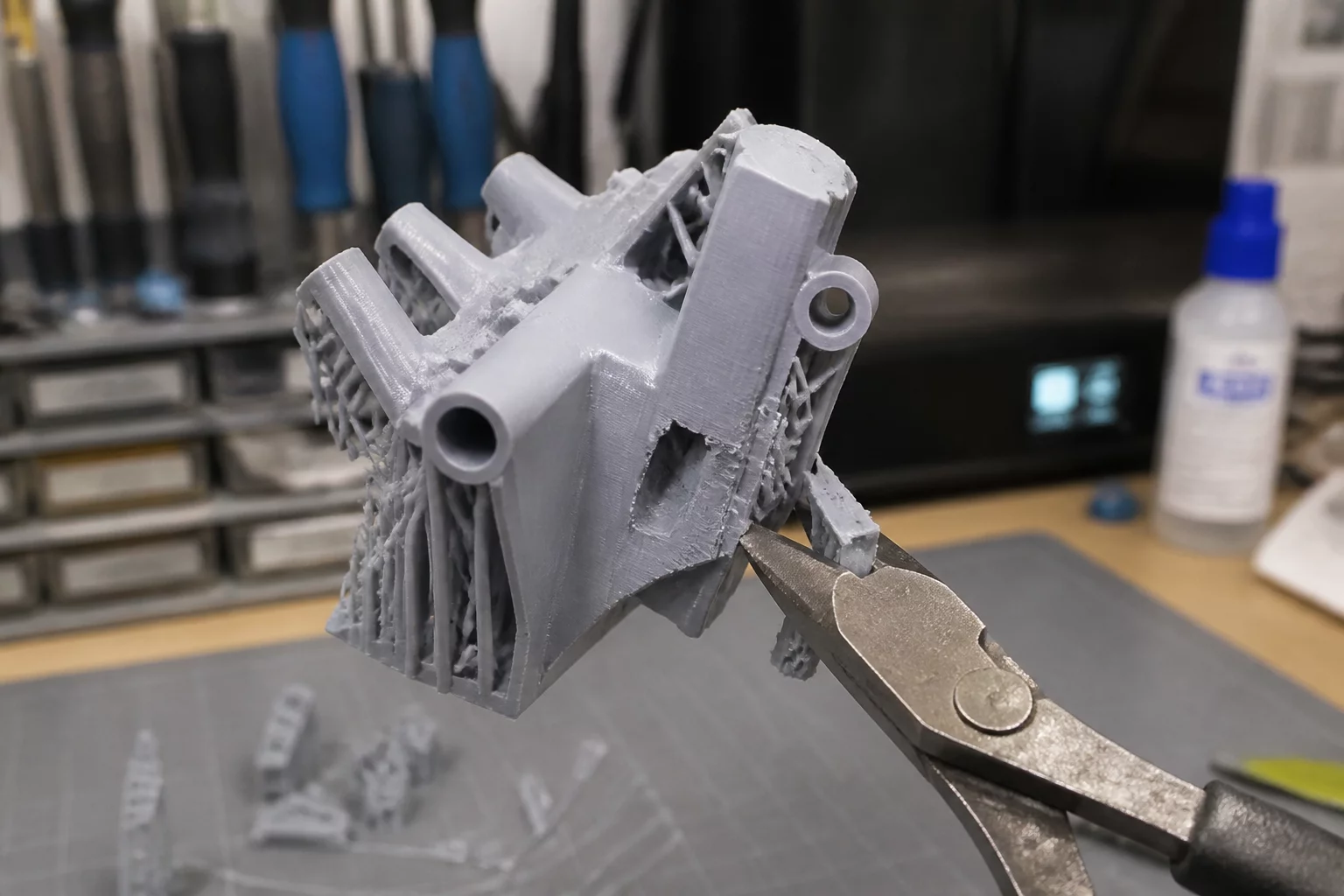
Support structure removal is a pivotal phase in the production of functional enclosures. For this sensor housing, the design included internal cavities and critical overhangs where traditional support removal often leaves unsightly scarring or dimensional deviations. This analysis focuses on the optimization of the interface layer—the bridge between the support material and the model surface—to ensure clean breakaway characteristics without compromising the part's structural walls.
The trial utilized a PETG filament, which is known for high interlayer adhesion, making support removal particularly challenging. We tested various Z-distance offsets, eventually settling on a 0.25mm gap. This configuration allowed the supports to maintain the overhangs while providing enough separation for the structures to be pulled away in monolithic pieces using standard workshop tools. This methodical approach prevented the common issue of "pitting" where support tips fuse too deeply into the model's outer shell.
Furthermore, the investigation looked at the impact of support density on cooling. In earlier versions, high-density supports restricted airflow around the overhang, leading to localized heat buildup and sagging. By switching to a 15% grid pattern and increasing the cooling fan speed for the interface layers, we achieved a much sharper edge profile. These refinements are essential for enclosures that must fit perfectly into larger assemblies without additional sanding or manual finishing.
Technical Iteration Analysis
Z-Gap Calibration
Optimized the vertical separation to 0.25mm to balance part stability with easy post-processing.
Support Interface Pattern
Implemented a dense interface floor that distributed heat evenly and improved surface finish.
Cavity Access Design
Adjusted the enclosure geometry to allow standard pliers to reach deep internal support structures.
Thermal Profile Management
Increased local cooling by 20% on overhanging layers to reduce plastic fusion at contact points.
Final Assessment
The refined support strategy resulted in a 40% reduction in post-processing time. The sensor enclosure now exhibits a clean internal finish that meets the strict tolerances required for sensitive optical components. By treating the support removal as a critical design variable rather than an afterthought, we have achieved a repeatable manufacturing process that maintains high aesthetic and functional standards across multiple production batches.