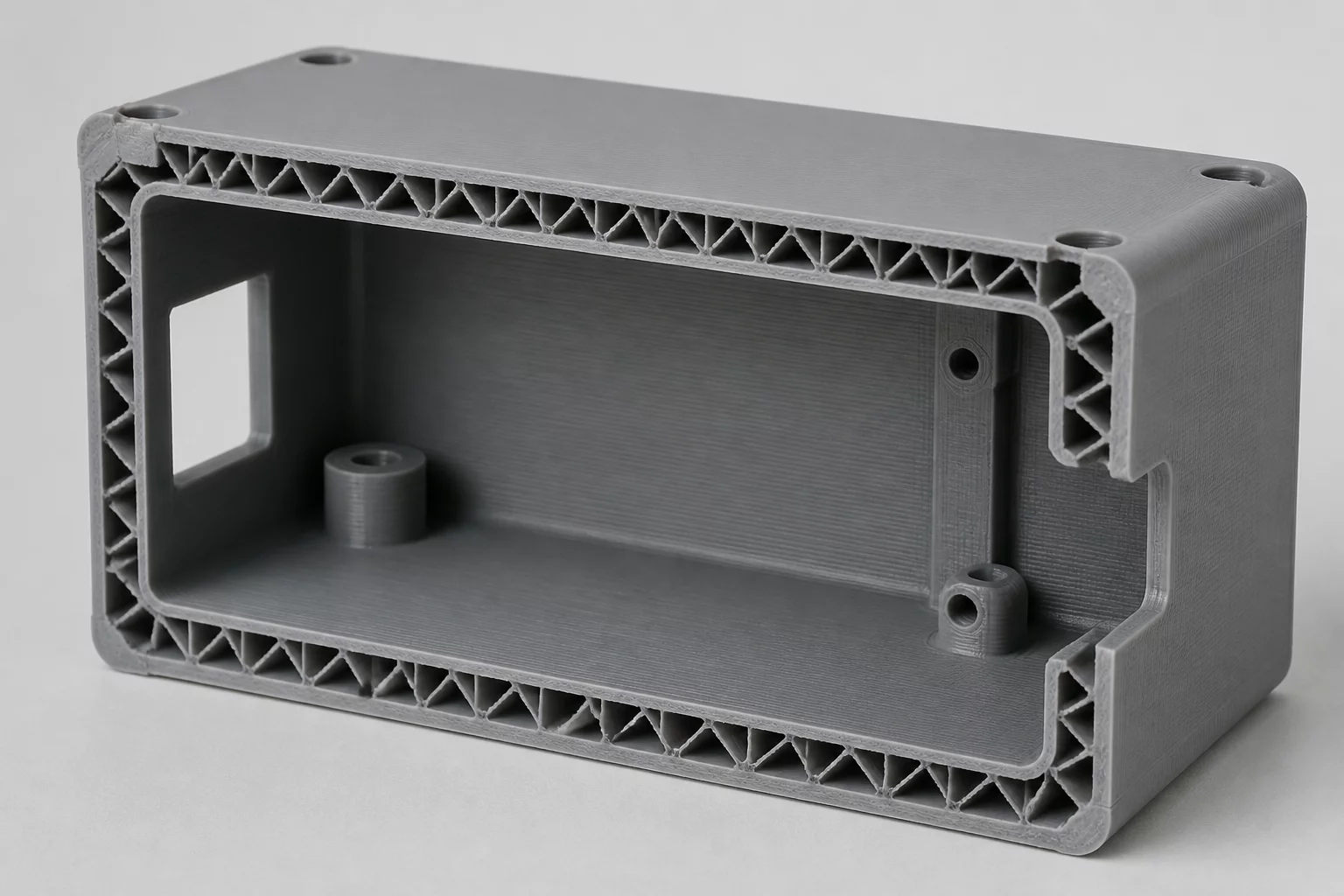
Designing an effective electronics enclosure requires a deep understanding of the stresses the part will endure in the field. This analysis focuses on a specific sensor housing designed for high-vibration industrial environments. The original design, featuring a standardized 1.2mm wall thickness, proved insufficient when subjected to lateral impact testing. The goal of this iteration was to identify a thickness that provides structural integrity without causing excessive thermal warping during the FDM printing process.
In the second trial, the walls were thickened to a uniform 2.4mm. While this solved the rigidity problem, it introduced significant cooling issues. The high thermal mass of the ABS material caused the corners to pull away from the heated bed, leading to dimensional inaccuracy. The third and final iteration utilized a more nuanced approach, applying 2.0mm thickness to the large flat faces and 3.0mm to the structural corners and mounting points. This specific configuration successfully passed all drop tests while maintaining the required 0.2mm dimensional tolerance.
Technical Iteration Analysis
Wall Rigidity
Transitioning from 1.2mm to 2.0mm eliminated visible shell flex during assembly.
Cycle Optimization
Optimized wall loops reduced the print time by 18% compared to the heavy-duty V2 prototype.
Thermal Shrinkage
Modified corner geometry suppressed ABS warping at the print bed interface.
Tolerance Check
Verified 0.5mm clearance for internal PCB slides after wall reinforcement.
Final Acceptance Criteria
The iteration process demonstrated that brute-force thickening of walls often leads to diminishing returns in terms of material waste and thermal stress. By implementing a variable thickness strategy, the enclosure achieved the necessary resistance without the bulk of the initial V2 prototype. This result is now standard for all future sensor housing projects within the department, ensuring a balance between protection and cost-effective production.