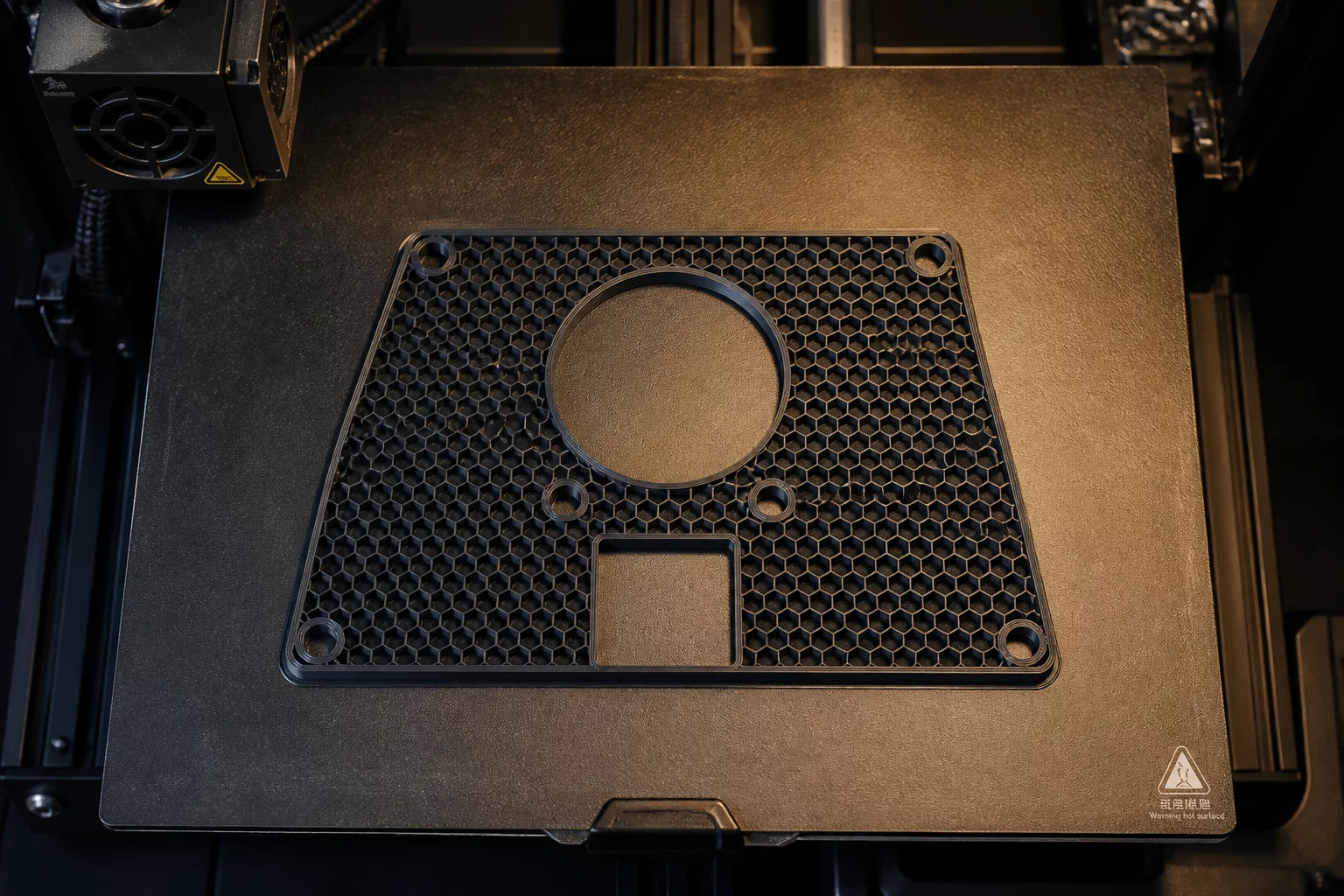
The structural integrity of a mounting plate depends heavily on the internal support architecture rather than just the exterior wall thickness. In this iteration, the team focused on addressing shear failure observed in earlier prototypes using 15% grid infill. The grid pattern, while fast to print, created weak points at the intersection of lines, leading to delamination under heavy mechanical stress.
The transition to a 25% honeycomb pattern significantly redistributed the internal loads. Honeycomb structures provide multi-directional support, which is critical for parts that face forces from multiple angles. Observations during testing showed that the hexagonal cells effectively absorb energy, preventing the propagation of micro-cracks throughout the part. This specific adjustment added roughly 8% to the total print time but increased the peak load capacity by nearly 22%.
The decision to optimize the infill rather than simply adding more outer perimeters was driven by the need to maintain tight external tolerances. Adding walls often leads to dimensional blooming in certain filaments, whereas adjusting the internal honeycomb structure keeps the outer dimensions stable while stiffening the core. We found that the 25% density provides the 'sweet spot' for this specific geometry. Any higher density yielded diminishing returns in strength while significantly increasing the risk of heat buildup and warping during the cooling phase.
Technical Iteration Analysis
Switched to Honeycomb for isotropic strength.
Increased to 25% to prevent internal buckling.
Set to 15% for better wall-to-infill bonding.
Reduced infill speed to 80mm/s for better precision.
Final Performance Review
Post-adjustment testing confirmed that the mounting plate now meets the required safety factor for industrial enclosures. The honeycomb core resists compression much better than the previous grid, ensuring that the bolt holes do not collapse when tightened to the specified torque. While material usage increased slightly, the reduction in part failure rates more than compensates for the additional filament cost.
- Static Load: Withstands 45kg without structural compromise.
- Torque Resistance: Bolt seats remained intact at 5Nm.
- Weight Change: +12g (+6% total weight).