ABS Warpage Analysis
Evaluating thermal contraction and adhesion challenges in industrial 3D printing workflows.
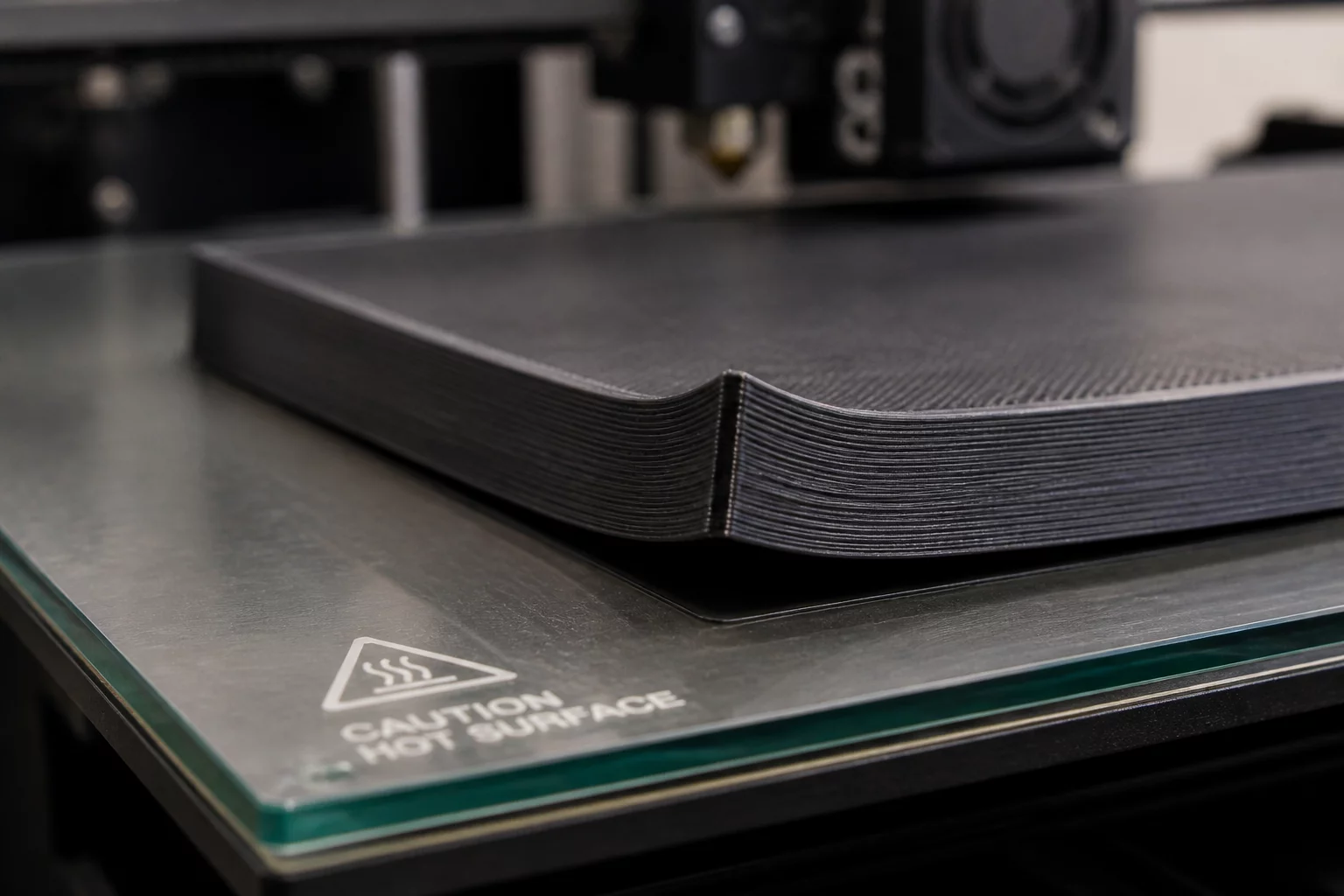
Acrylonitrile Butadiene Styrene (ABS) has long been a staple in the 3D printing industry due to its impact resistance and toughness. However, it presents a notorious challenge for engineers: thermal warpage. This phenomenon occurs as the extruded plastic cools and shrinks. Unlike PLA, which has a low thermal expansion coefficient, ABS exhibits significant volumetric contraction upon cooling, which creates internal stresses that pull the edges of the print upward away from the build plate.
The Mechanics of Thermal Stress
Warpage is primarily driven by the temperature gradient between the nozzle and the ambient environment. As the molten plastic leaves the nozzle at roughly 250°C and hits a cooler surface, it immediately begins to contract. If the layer below has already cooled significantly, the new layer pulls on it as it shrinks. Over many layers, these cumulative forces become strong enough to overcome the adhesive bond between the part and the heated bed.
Critical Observations in Failed Iterations
During our field tests, we noticed that sharp corners are the most vulnerable points. The stress vectors converge at these geometric transitions, making them the first points of failure. In large-format prints, the center of the part may remain flat while the periphery lifts by several millimeters, often causing the nozzle to collide with the tilted part in subsequent layers. This usually results in a complete print failure or significant dimensional inaccuracy.
Best Practices for Warpage Mitigation
- Passive and Active Enclosures: Maintaining a stable, elevated ambient temperature (around 40-50°C) is essential to slow down the cooling process and reduce internal stress.
- Bed Surface Selection: PEI sheets or specialized adhesives are mandatory for ABS. Using a slurry of ABS dissolved in acetone can also create a chemical bond that resists lifting.
- Brims and Rafts: Adding a wide brim increases the surface area in contact with the bed, providing more mechanical leverage to counteract the pulling forces.
- Infill Density Management: High infill percentages often exacerbate warping because there is more material to shrink. Using a lower infill or specialized patterns like gyroid can help distribute the stress more evenly.
In conclusion, while ABS offers superior mechanical properties for functional parts, it requires a controlled environment. Success with this material is less about the printer itself and more about the management of thermodynamics across the entire build volume.