HIPS Dissolvable Supports
Optimizing complex dual-extrusion geometries using High Impact Polystyrene and D-Limonene solvents.
The Role of HIPS in Advanced FDM Printing
High Impact Polystyrene (HIPS) is often overshadowed by its more common counterparts like PLA or PETG, yet it remains an essential tool for engineers working with ABS or ASA. Its primary utility lies in its chemical compatibility with styrene-based materials and its unique solubility in D-Limonene. When printing parts with internal cavities, complex overhangs, or intricate mechanical assemblies, breakaway supports often fail to provide a clean finish or become impossible to remove manually. HIPS serves as a sacrificial skeleton that maintains the geometric integrity of the main part before being chemically erased.
Thermal Synergy with ABS and ASA
One of the greatest challenges in dual-extrusion printing is matching the thermal contraction rates of the two materials. If the support material cools and shrinks significantly faster or slower than the model material, the part will likely warp, delaminate, or detach from the bed entirely. HIPS is particularly effective here because its glass transition temperature and printing temperature range almost perfectly mirror those of ABS. This synergy allows the entire printed assembly to cool uniformly, minimizing internal stresses that lead to structural failure.
The Dissolution Process: D-Limonene Handling
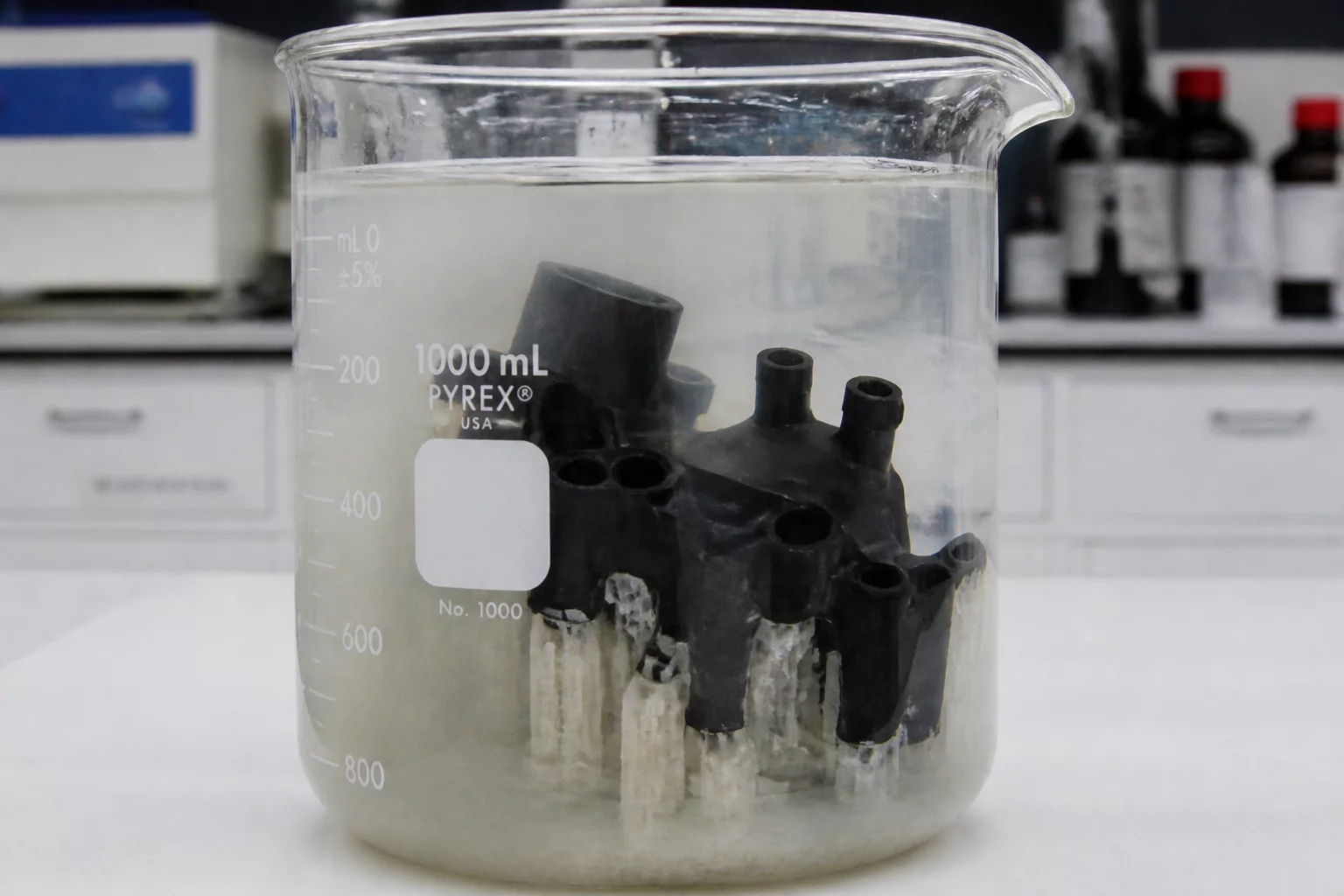
Unlike PVA, which dissolves in plain water, HIPS requires a citrus-based solvent called D-Limonene. The process is straightforward but requires patience and safety precautions. Typically, a finished print is submerged in a bath of the solvent for 8 to 24 hours. The HIPS turns into a soft, gel-like substance before eventually dissolving completely into the liquid, leaving the primary ABS part untouched and free of support scars. It is important to use an airtight container for this process to prevent the solvent from evaporating and to ensure the room is well-ventilated.
Technical Best Practices
- Zero-Gap Interface: Because the material is dissolved away, you can set your Z-distance for supports to 0mm. This results in a perfectly smooth surface finish on the underside of overhangs.
- Bed Adhesion: HIPS adheres well to Kapton tape or PEI sheets. Since it requires a bed temperature of 90-110°C, ensure your printer enclosure is closed to maintain a stable ambient temperature.
- Storage Requirements: While HIPS is less hygroscopic than PVA, it can still absorb atmospheric moisture over time. Keeping spools in a dry box with silica gel ensures that the extrusion remains consistent and free of air bubbles.