PVA Water Soluble Tests
Evaluating dissolution rates, adhesion compatibility, and shelf-life stability for complex dual-extrusion geometries.
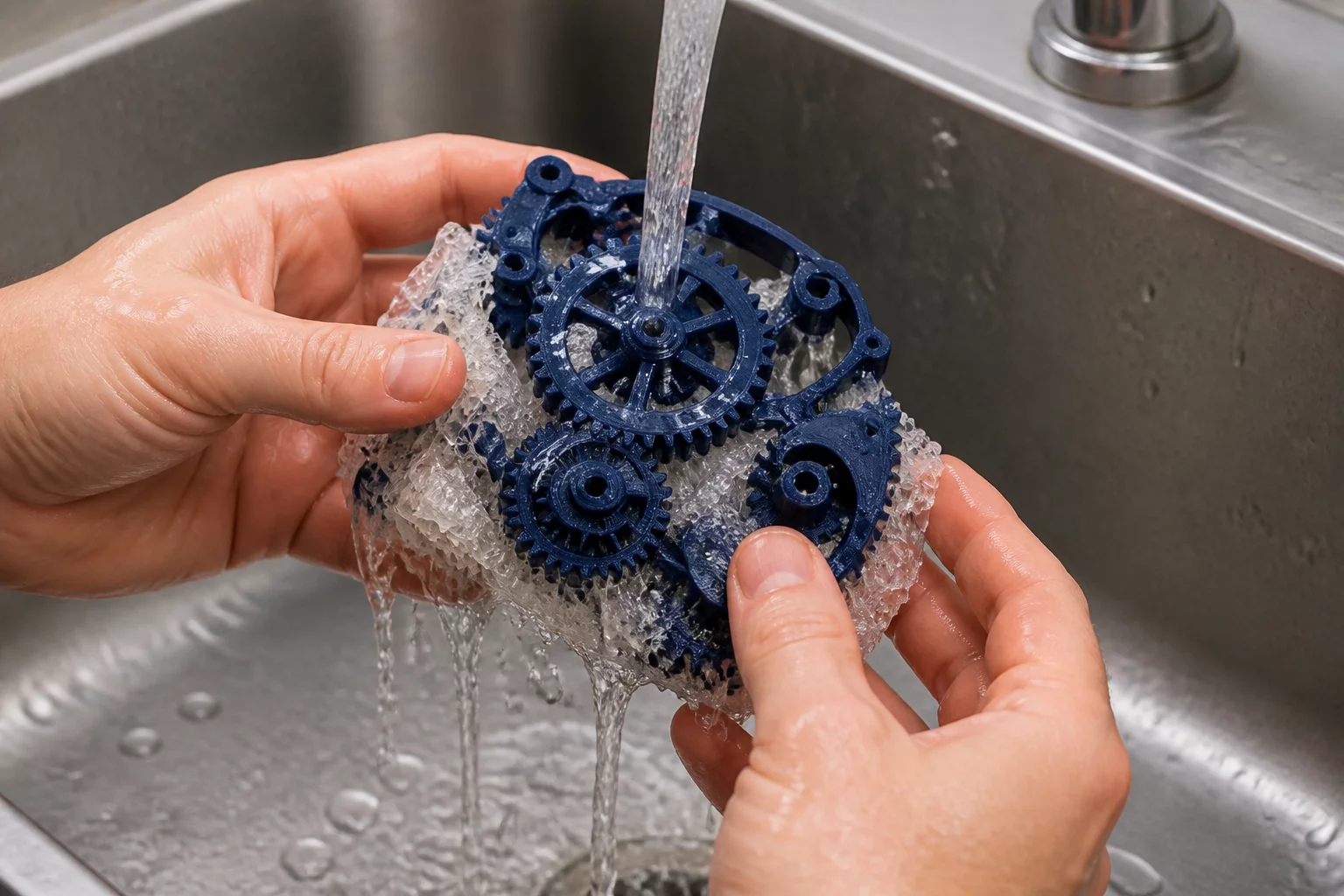
The Role of Soluble Support in Complex Geometries
Polyvinyl Alcohol (PVA) represents one of the most significant advancements in FDM 3D printing. It allows designers to create internal cavities, overhangs, and interlocking mechanisms that would be impossible to clean using traditional breakaway supports. By utilizing a dual-extrusion setup, the printer builds the model with a primary material—usually PLA—and the support structures with PVA.
Dissolution Dynamics and Temperature Sensitivity
Our tests focused on the speed of removal under various conditions. While PVA dissolves in room-temperature water, increasing the temperature to 40°C significantly accelerates the process. We observed that active agitation, such as a circulating pump or an ultrasonic cleaner, reduces the dissolution time by nearly 40%. However, exceeding 50°C risks deforming the primary PLA part, which has a relatively low glass transition temperature.
Compatibility with Primary Filaments
PVA bonds exceptionally well to PLA, creating a seamless interface that results in a smooth surface finish once removed. Compatibility with PETG is more challenging; while it can be done, the chemical bond is weaker, often requiring specialized PVA+ variants designed for higher-temperature materials. We found that Nylon and ABS are generally poor candidates for standard PVA due to the extreme difference in printing temperatures and bed adhesion requirements.
The Critical Importance of Moisture Control
The greatest challenge with PVA is its extreme hygroscopicity. During our 48-hour exposure test in a 50% humidity environment, the filament absorbed enough moisture to cause severe bubbling and popping at the nozzle. This results in inconsistent extrusion and failed support structures. It is imperative to print PVA directly from a dry box and store it in vacuum-sealed bags with fresh desiccant when not in use.
Environmental Impact and Disposal
One common question involves the disposal of the resulting PVA solution. Since PVA is biodegradable and non-toxic, it is generally safe to dispose of down a standard drain connected to a wastewater treatment facility. However, it is recommended to dilute the solution with plenty of hot water to prevent the concentrated polymer from coating the pipes as it cools.